
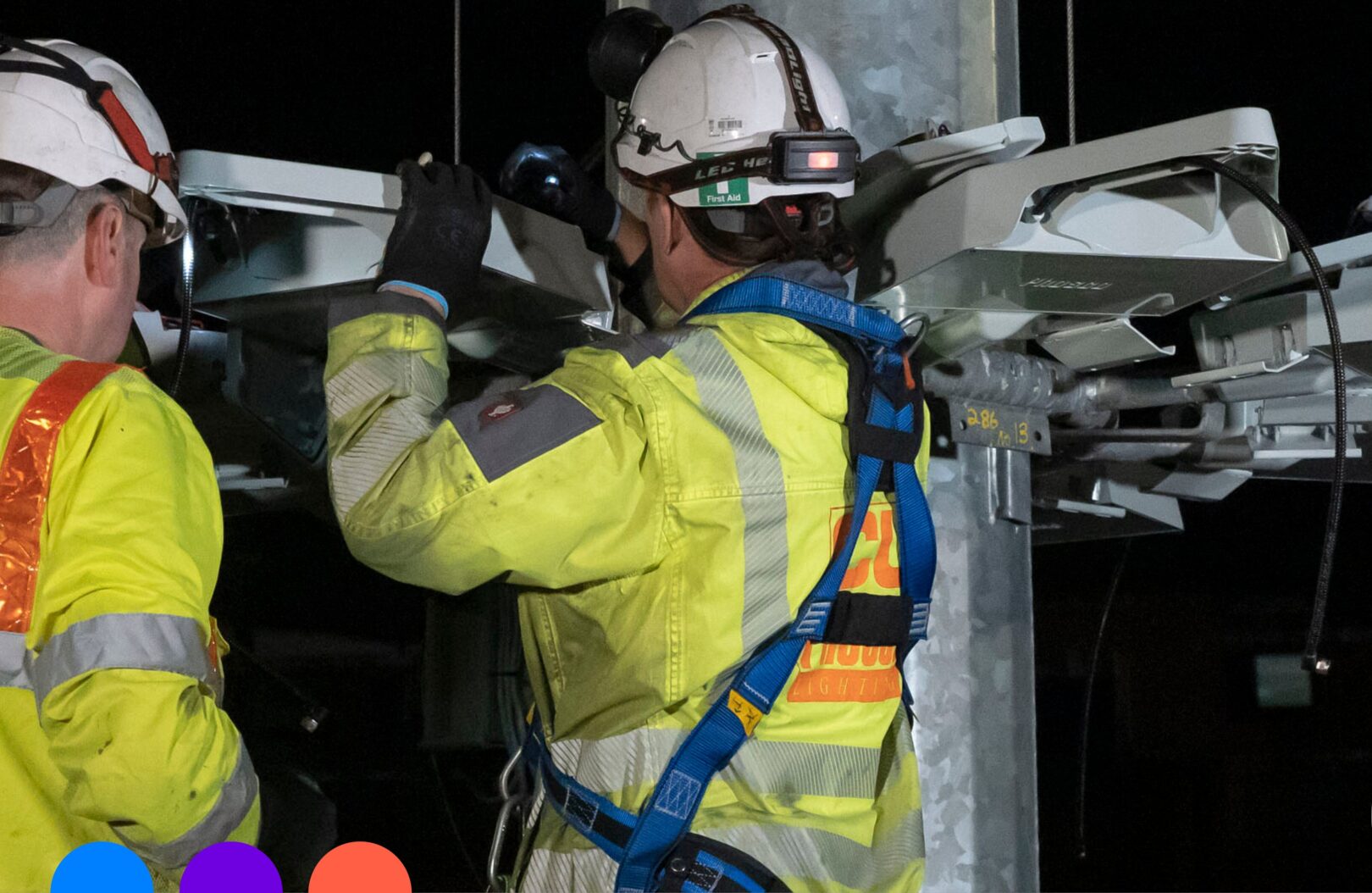
High masts are long-term infrastructure assets. Across airports, ports, highways and major industrial sites, they provide reliable high-level illumination over large operational areas. Many of these structures were designed with decades of service in mind, and, structurally, they continue to perform exactly as intended.
When that happens, asset owners face a decision. Do you replace the entire high mast, including steelwork and foundations, or upgrade the operational system within the existing structure?
In many cases, retrofit is the smarter engineering solution.
UNDERSTANDING WHAT ACTUALLY FAILS
Raise-and-lower systems operate in demanding environments. Coastal exposure, airborne debris (including bird droppings), high winds and temperature extremes all place stress on mechanical components. Over time, traditional latching mechanisms can become unreliable. Debris can interfere with moving parts. Corrosion can compromise performance. Lantern carriages may stick or fail to return smoothly to ground level.
In operational environments, this is more than an inconvenience. If a headframe becomes stuck at height, maintenance is delayed. Access becomes more complex. In some cases, large sections of an apron, roadway or operational zone may need to be restricted while the issue is resolved.
The key point is this: the structural mast may remain sound, while the mechanical system is no longer dependable.
Replacing the entire asset is not always proportionate to the problem.
STRUCTURAL LIFE VERSUS MECHANICAL LIFE
High mast structures are designed for longevity. With appropriate inspection and maintenance, many remain within structural tolerance decades after installation. Fatigue, corrosion protection and foundation integrity must always be assessed properly, but in a significant number of cases the steelwork itself does not require replacement.
A thorough structural health check is therefore the starting point for any responsible retrofit decision. This includes reviewing the condition of the shaft, connections, foundations and load capacity. If the mast is structurally sound, upgrading the raise-and-lower mechanism can extend its operational life significantly.
Retrofitting focuses investment where it is actually needed.
THE OPERATIONAL CASE FOR RETROFIT
In live environments, especially airports and ports, operational disruptions carry real costs.
At Hamad International Airport, an existing latching raise-and-lower system had begun to experience failures caused by debris becoming embedded in the mechanism. On some occasions, the headframe became stuck for up to two days before it could be returned to ground level for maintenance.
Following a structural survey, CU Phosco installed its In-Tension Raise & Lower System as a retrofit solution within the existing high mast structures. During the demonstration, the lantern carriage could be lowered safely to the base of the mast in approximately 20 minutes.
The impact was immediate. Maintenance could be carried out safely at ground level. Operational disruption was reduced. The need to close large sections of the apron during maintenance activities was significantly minimised. Following a successful pilot, the airport committed to a larger-scale upgrade programme.
This is the practical value of retrofit. It improves reliability without rebuilding the entire asset.
EXTENDING ASSET LIFE IN PRACTICE
A similar approach was taken at the Eastern Harbour Crossing in Hong Kong. The existing raise-and-lower system was more than 38 years old, and many components were in functional decline. The objective was clear: extend the life of the high masts, reduce future maintenance costs and ensure reliable operation for years to come.
Following an on-site inspection and consultation with structural engineers, CU Phosco supplied and supported installation of a complete In-Tension Raise & Lower System, including a winch, headframe, wire ropes, and lantern carriage.
The result was not simply a repair. It was the renewal of operational capability within an existing, structurally sound asset.
RETROFIT VERSUS FULL REPLACEMENT
Full mast replacement involves fabrication of new steel structures, civil works, foundation considerations, traffic or operational closures and extended programme time. It also carries significantly higher capital expenditure.
Retrofit, by contrast, concentrates on upgrading the mechanical system within the existing mast. It avoids unnecessary structural replacement where the asset remains sound. It reduces civil intervention and shortens delivery programmes. In many cases, it allows phased installation to minimise operational impact.
There is also a sustainability dimension. Retaining an existing steel structure avoids the embodied carbon associated with new fabrication and installation. In an era where asset optimisation and environmental performance are increasingly scrutinised, extending the life of existing infrastructure is both commercially and environmentally responsible.
ENGINEERING THE IN-TENSION DIFFERENCE
Traditional latching systems rely on mechanical engagement at height. In contaminated or high-debris environments, this can create vulnerability.
The In Tension Raise & Lower System operates on a different principle, maintaining controlled tension throughout the operation. Double-drum winches, engineered headframes and high-specification wire ropes are designed to provide consistent performance over long service periods. Maintenance is conducted safely at ground level, reducing risk exposure for operatives and simplifying inspection regimes.
Retrofitting does not compromise structural integrity. It enhances operational reliability within the original design envelope.
WHEN REPLACEMENT IS STILL REQUIRED
There are circumstances where full replacement is the correct decision. If structural fatigue, severe corrosion or foundation failure is identified, the priority must always be safety and compliance.
A responsible retrofit strategy begins with an engineering assessment by a qualified and independent engineer. Robust non-destructive testing and assessment is essential in making a decision to retain or replace a mast, which must be based on evidence, not assumption. NDT guidance is available within Institution of Lighting Professionals Guidance Note 22, Asset-Management Toolkit: Minor Structures (ATOMS).
Where the structure remains sound, however, replacing it entirely may not be proportionate.
A STRATEGIC ASSET DECISION
High masts, ranging from 3 metres to 60 metres in height, are installed across roads, motorways, airports, ports and sports venues worldwide. They are designed as long-term infrastructure investments.
The question asset owners should ask is not simply, “Is the system failing?” but “What is the most proportionate engineering response?”
If the structural mast is performing as intended, upgrading the raise-and-lower mechanism may deliver the reliability, safety and lifecycle performance required without the cost and disruption of full replacement.
Retrofit is not a temporary fix. It is a considered engineering intervention that extends asset life, improves operational resilience and protects long-term investment.
Before planning to replace a high mast entirely, it is worth asking whether the smarter solution lies within the structure already in place.
Find out more about CU Phosco High Masts