
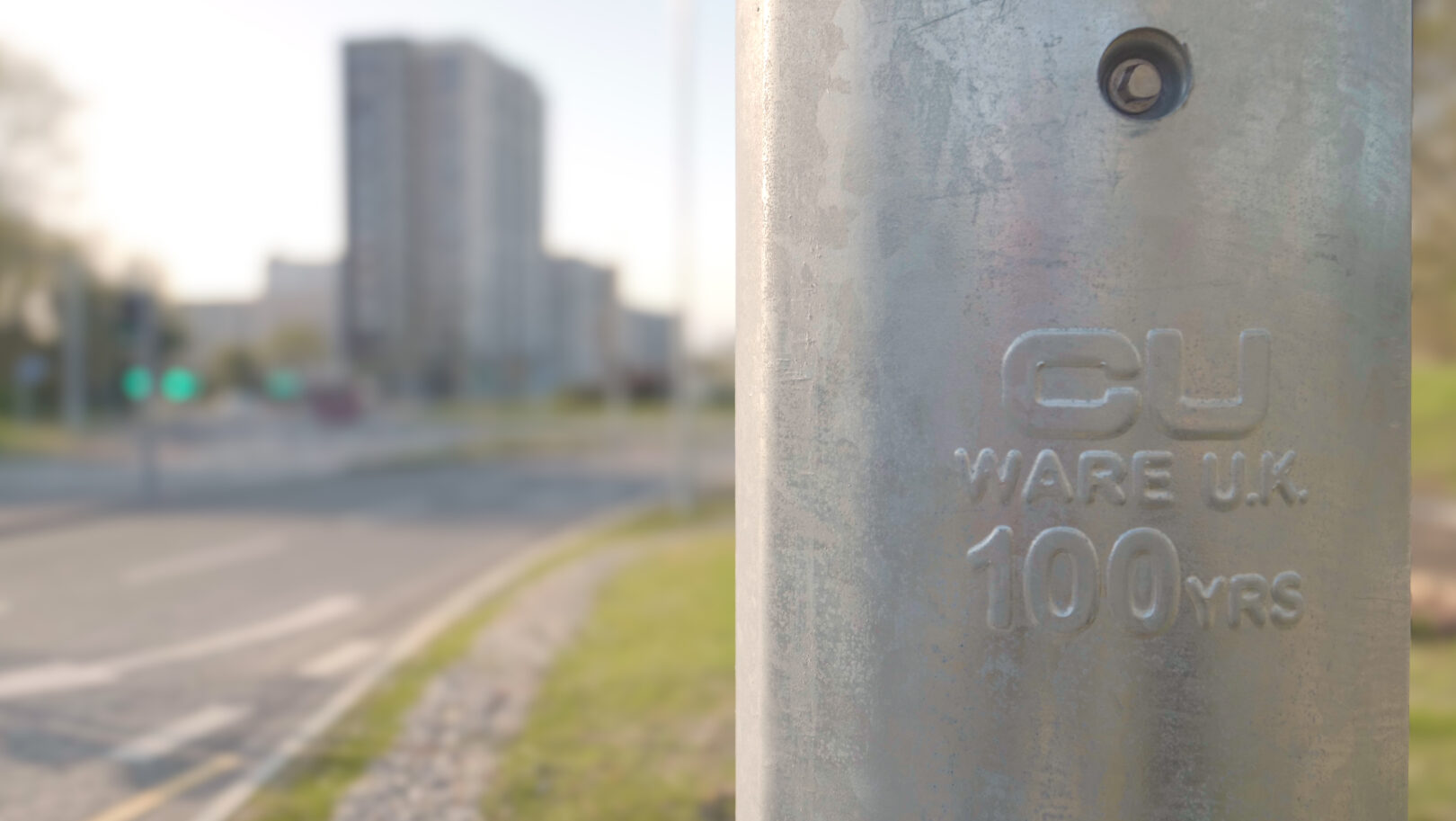
Choosing the right lighting column for UK street lighting schemes requires more than selecting a compliant product.
Street lighting is often judged by what people can see. The light, the uniformity, the way a space feels after dark. But the real story often sits beneath it. The column.
For something so fundamental, lighting columns are rarely given the same level of scrutiny as luminaires or controls, often becoming a late-stage decision rather than a strategic one. Yet they carry the load, literally and strategically, for everything modern infrastructure is asking of the street.
As the UK’s leading lighting column manufacturer and recent HEA/HEMSA Company of the Year, CU Phosco continues to support local authorities and highways teams at scale.
FROM LAMPLIGHTERS TO MULTI-FUNCTIONAL INFRASTRUCTURE
Public street lighting dates back to the 16th century, when lamplighters would walk the streets at dusk, igniting candles and oil lamps by hand, before returning at dawn to extinguish them.
Over time, lighting evolved through gas and into electric systems, but one constant remained. The need to elevate a light source safely and reliably above the public realm.
Today, columns are no longer just a support structure. They are expected to accommodate lighting, signage, CCTV, EV charging, communications equipment and future technologies that may not even be specified yet.
What was once a simple asset has become critical infrastructure.
WHY GALVANISED STEEL REMAINS THE INDUSTRY STANDARD
Despite advances in materials, galvanised steel continues to dominate the UK market, and for good reason.
It offers a balance that is difficult to match, combining strength and structural reliability across a wide range of applications with proven performance in UK environmental conditions. This is supported by cost-effective manufacture and installation, alongside compatibility with a broad range of mounting requirements.
From side roads and footpaths through to highways, car parks and transport hubs, galvanised steel columns provide a consistent and scalable solution.
At CU Phosco, around 50,000 lighting columns are manufactured each year to meet this demand, supporting local authorities and highways teams across the UK.
With decades of experience across lighting and telecoms infrastructure, this scale is backed by a deep understanding of how columns perform in real-world UK conditions.
All columns are produced in accordance with BS EN 40 and galvanised to ISO 1461, ensuring compliance with structural and corrosion protection requirements.
CORROSION, COATINGS AND REAL-WORLD PERFORMANCE
A galvanised column is typically designed for a 25-year life, but in practice, many exceed this significantly.
The reality is that lifespan is not defined by a single number but is influenced by a range of factors including location and exposure, whether urban, rural or coastal, along with atmospheric conditions and the thickness and performance of the zinc coating.
Guidance such as Institution of Lighting Professionals PLG-026 helps specifiers understand corrosion protection in steel structures, while tools like the Zinc Millennium Map provide indicative life expectancy across environments.
There is often concern around the appearance of galvanised finishes. Variations such as dull or mottled surfaces are normal and do not impact performance. In fact, a duller finish can indicate a stronger metallurgical bond between the zinc and steel.
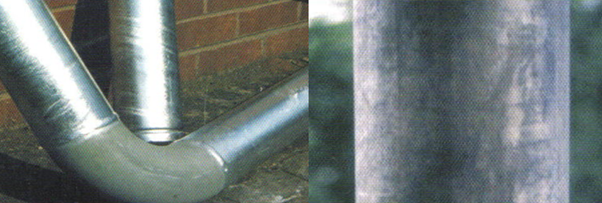
What matters is compliance. Standards require that coatings are free from defects such as blisters, uncoated areas or sharp points, ensuring durability and safety in service.
PAINTED COLUMNS: AESTHETICS VERSUS LIFECYCLE
In certain environments, particularly town centres or heritage areas, painted columns are specified for aesthetic reasons. While this can enhance visual integration, it introduces a long-term maintenance requirement.
Paint systems need to be inspected, maintained and reapplied over time. Without this, the protective benefit can diminish, potentially reducing the overall lifespan of the asset.
In this sense, painting is often a necessary choice for place-making, but it should be understood as a lifecycle commitment, not a one-off upgrade.
SUSTAINABILITY AND MATERIAL CHOICES
There is a common assumption that alternative materials, such as aluminium, offer a more sustainable solution.
However, environmental product data increasingly tells a different story.
Galvanised steel columns can deliver a strong environmental performance, often outperforming alternatives when assessed across the full lifecycle. Combined with durability and lower replacement rates, this makes them a compelling option from both a cost and carbon perspective.
For local authorities under pressure to balance budgets and sustainability targets, this is a critical consideration.
DESIGNING FOR THE NEXT 30 YEARS
Perhaps the biggest shift in recent years is not material or manufacturing, but expectation.
Lighting columns are no longer being specified purely for today’s requirements.
They must account for additional loading from future technologies, changing standards and compliance requirements, the integration of smart city infrastructure, and the need to balance longer asset life expectations with shorter technology cycles.
This creates a challenge. Designing a column for a 25–30-year life in an environment where connected technology may evolve every 5 years.
The answer lies in flexibility, robust design, and a clear understanding of future use cases at the point of specification.
GETTING SPECIFICATION RIGHT
For highways teams and local authorities, the challenge is no longer just selecting a compliant column.
The key question is now: What will this column need to support over its lifetime?
That means considering structural loading, both current and future, as well as environmental exposure and corrosion risk, alongside maintenance strategy, whole-life cost, and compatibility with evolving infrastructure.
In practice, this means engaging earlier in the design process, asking the right structural and environmental questions, and avoiding treating the column as a last-stage decision.
Get this right, and the column becomes a long-term asset. Get it wrong, and it becomes a constraint.
A FOUNDATION WORTH GETTING RIGHT
Lighting columns may not always be the most visible part of a scheme, but they are one of the most important.
They underpin safety, reliability and the ability to adapt infrastructure over time.
In an era where streets are expected to do more than ever, from supporting connectivity to enabling decarbonisation, the humble column has never carried more responsibility.
And that makes getting it right at the start more important than ever.
If you’re planning a street lighting scheme and want to ensure your columns are specified for long-term performance, speak to the CU Phosco team. From structural design to corrosion protection and future loading, we can support you at every stage of your project.