

England's planning system is changing, and telecoms has been singled out for clearer support.
Published in August, the new National Planning Policy Framework (NPPF) introduces a clearer distinction between the policies used to make local plans and the national policies used when deciding individual development proposals. The Government says the changes are intended to make development management more certain, consistent and streamlined.
For telecoms, the direction is particularly interesting. The Framework includes a dedicated chapter on high-quality communications, with national decision-making policies designed to “support the expansion and upgrading of telecommunications infrastructure”.
At a time when networks are being continually upgraded to support standalone 5G, gigabit connectivity, greater capacity and growing demand for reliable communications, creating a clearer route through the planning system could help remove some of the uncertainty surrounding deployment.
But there is another aspect of the policy that deserves attention from an engineering perspective: the emphasis it places on existing infrastructure.
Under the new Framework, proposals for the expansion or upgrading of telecommunications networks should use existing masts, buildings and other structures already employed for telecoms, or upgrade or replace existing infrastructure, unless there is no reasonable opportunity to do so. Consideration should also be given to meeting consumer needs, efficient network operation and providing reasonable capacity for future expansion.
For an industry with a substantial network of infrastructure already in place, that makes good practical sense. It also makes understanding the condition and capacity of those existing assets increasingly important.
A structure designed and installed years ago may now support a very different equipment configuration from the one originally envisaged. Antennas are replaced, additional equipment is installed, sites are shared, and networks evolve. Each change has the potential to alter the loads imposed on the structure.
Making better use of an existing site therefore has to start with understanding what the structure can safely accommodate. But where existing infrastructure does need to be replaced, there is also an opportunity to consider whether the replacement asset could work harder.
Both are areas where CU Phosco can draw on more than 40 years of telecommunications engineering experience.
Our Global Design Check (GDC) service provides independent structural verification for existing telecommunications infrastructure, including monopoles, lattice towers, rooftop frames, columns, equipment platforms and headframes.

Understanding the capacity of existing infrastructure
A GDC assesses the structural integrity and capacity of an existing asset against its current and proposed equipment loading. It gives contractors, consultants, Mobile Network Operators and tower owners the engineering information they need before equipment upgrades, site-sharing arrangements or network expansion projects proceed.
This approach also fits closely with the direction of the new planning policy.
If an existing site can accommodate new equipment safely, understanding that capacity early can provide greater confidence in the proposed solution. Where it cannot, identifying the constraint at an early stage allows other options to be considered, whether that means strengthening the existing structure, changing the equipment configuration or looking at an alternative solution.
This is particularly relevant if changes elsewhere in the planning process result in proposals moving through decision-making more efficiently. There is little benefit in removing uncertainty at the planning stage only for a project to encounter an avoidable structural issue further into its development.
It is not a matter of carrying out fewer checks to speed up deployment. The opportunity is to ensure the necessary engineering work is completed early enough to inform the decisions that follow.
What if existing infrastructure needs replacing?
The NPPF also recognises the potential to upgrade or replace existing infrastructure, while requiring proposals to be sited and designed to minimise visual impact.
That opens up another consideration for towns and cities. Where an existing asset such as a street lighting column or CCTV mast needs replacing, could the new structure do more than simply replace what was there before?
CU Phosco's Connected Urban Smart Pole provides one possible approach. Designed as a direct replacement for existing street lighting infrastructure, or for new installations, it combines street-level telecommunications with other services in a single, compact footprint. It can accommodate both macro and small cell technology alongside lighting, CCTV and other smart city infrastructure.
This provides an alternative to adding another standalone telecoms structure to the streetscape. Connected Urban is aesthetically designed to be sympathetic to the local environment, with the appearance of street infrastructure rather than a conventional telecoms monopole, while providing the capacity needed to support greater connectivity and radio network densification.

Connected Urban Smart Pole 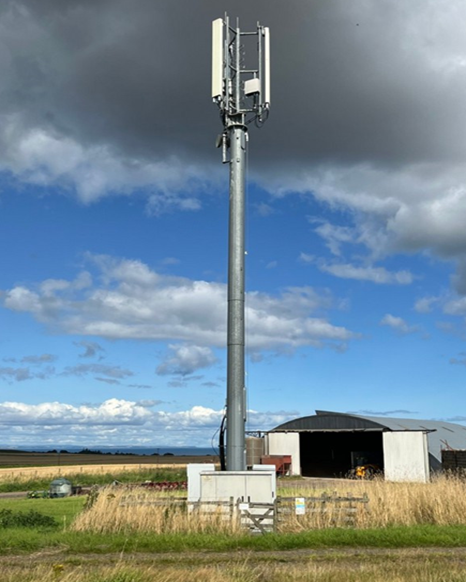
Monopole Telecoms Mast
For local authorities and network operators, it creates an opportunity to think differently about infrastructure replacement. Instead of replacing a lighting column or other asset like for like, there may be opportunities to retain its existing function while introducing additional connectivity within the same small footprint.
That approach sits naturally alongside the NPPF's emphasis on making use of existing sites, upgrading or replacing existing infrastructure and minimising the visual impact of telecommunications development.
Looking beyond an individual upgrade, there is also a longer-term asset management benefit.
Understanding the structural capacity of existing infrastructure can help determine what can continue to be used, what might be strengthened and where replacement is required. Where a new structure is needed, there is then an opportunity to consider future requirements from the outset.
That could mean providing capacity for future telecoms equipment or considering whether a replacement structure can support more than one infrastructure requirement.
As network demands continue to change, taking this longer-term view can help infrastructure owners make more informed decisions about the assets already in place and what they may need to support in future.
The new NPPF applies to England, but the pressures behind these changes are not unique to the English market. Operators and infrastructure owners internationally face many of the same challenges: increasing demand for connectivity, ongoing network upgrades, and the need to deliver new capacity efficiently while maintaining appropriate technical, planning, and environmental safeguards.
Whether England's approach provides lessons for other markets will depend on how the new framework works in practice. But the principle of removing unnecessary uncertainty while making better use of existing infrastructure has much wider relevance.
For CU Phosco, there is an important engineering point within that conversation. Clearer decision-making depends on good information and an understanding of the infrastructure already in place: what can be reused or upgraded and, where replacement is necessary, what the new asset may need to support.
As England's planning system changes, understanding what existing infrastructure can support, and thinking more strategically about the assets that replace it, will become increasingly important.
To learn more about CU Phosco's approach to telecoms infrastructure, including our Global Design Check service and Connected Urban solutions, visit our telecoms page.