
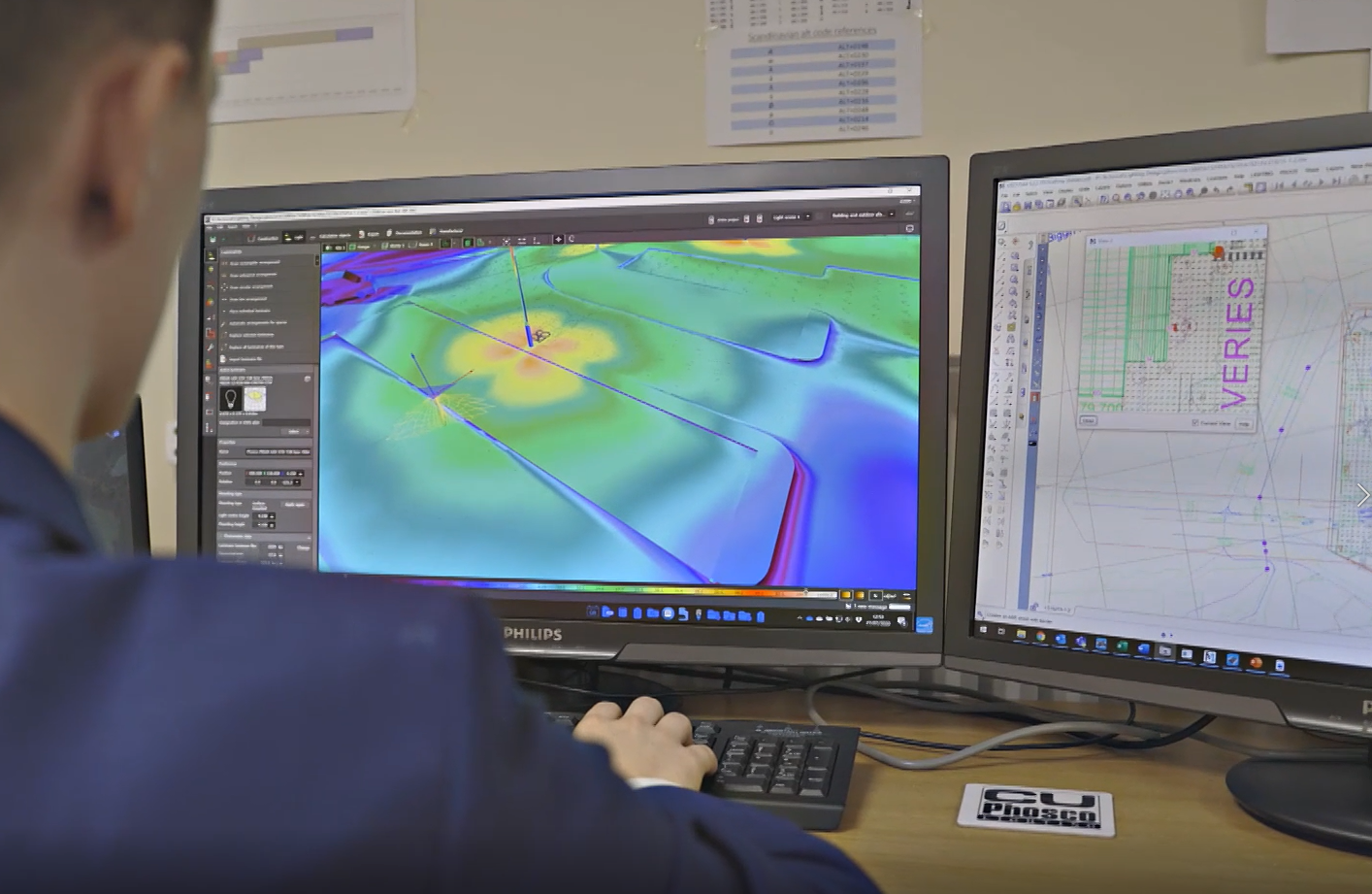
When it comes to effective lighting design, it's not simply about how much light a luminaire produces, but how it is distributed.
This is where photometry plays an important role.
From street lighting and public spaces to ports and airports, photometric data helps lighting designers select the most appropriate luminaires and optics for each application. Ensuring light is delivered where it is needed while considering energy efficiency, visual comfort and the surrounding environment.
WHAT IS PHOTOMETRY?
Photometry is the measurement of visible light and how it is emitted and distributed by a light source.
In exterior lighting design, photometric data provides information about a luminaire's light output, intensity and distribution. Rather than relying on wattage or lumen output alone, designers can use this information to understand how a luminaire will perform in a particular environment under certain conditions.
UNDERSTANDING THE LIGHTING DESIGN PROCESS
At C.U. Phosco, lighting design begins with understanding the application and its requirements.
Irina Pirtac, Lighting Design Manager at C.U. Phosco, explains:
“A good lighting design always starts with understanding what the space needs, not choosing a luminaire. Once we've established the requirements, we can identify the right luminaire family and then focus on selecting the optic that will deliver the best results.”
Luminaire selection is determined by both optical and mechanical performance.
Several factors influence optical performance, including correlated colour temperature (CCT), colour rendering index (CRI), efficacy, light distribution, glare control and spill light management.
Luminaire mechanical design encompasses all non-optical aspects of the luminaire, including the housing, mounting system, structural integrity, thermal performance, environmental protection and maintenance features, ensuring the product performs reliably throughout its service life.
While optics determine how light is distributed, the luminaire mechanical design determines how the luminaire is installed, aimed, protected, maintained and integrated into the environment.
From there, the process follows a logical sequence:

This structured approach ensures that the luminaire and its optics are appropriate for the application.
WHY OPTICAL DISTRIBUTION MATTERS
The optic controls how light is directed from the luminaire, influencing where it falls, how evenly it is distributed and how much is wasted in areas outside the intended space.
Different applications call for different distributions.
STREET LIGHTING
For roadways, the objective is generally to distribute light along and across the road to achieve the required lighting performance. The selected optic must work with factors such as column height, spacing, road width and luminaire positioning.
PORTS AND INDUSTRIAL AREAS
Large operational areas often require light to be delivered across considerable distances. Here, optical selection is particularly important in achieving the required coverage while managing glare and unwanted light spill.
AIRPORTS
Airport lighting presents its own challenges. Large operational areas require carefully controlled illumination, the right distribution helps designers direct light where it is needed while considering visibility, glare and the surrounding environment.
LIGHTING DESIGNER'S TIP – IRINA PIRTAC:
“It's worth remembering that the optic can make a significant difference to the final design. Two luminaires might have similar luminous flux, but how they distribute that light can be completely different. That's why we look closely at the photometric data, luminaire distribution and the task to complete rather than simply comparing lumens and powers.”
UNDERSTANDING LIGHT DISTRIBUTION THROUGH ISOLUX DIAGRAMS
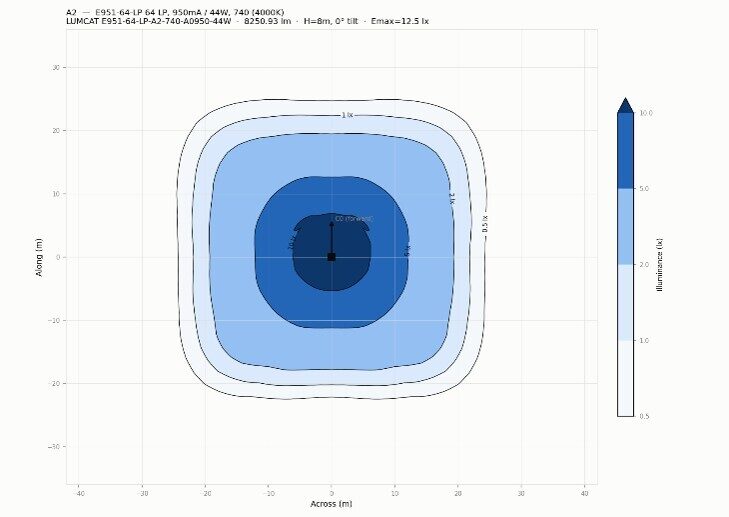
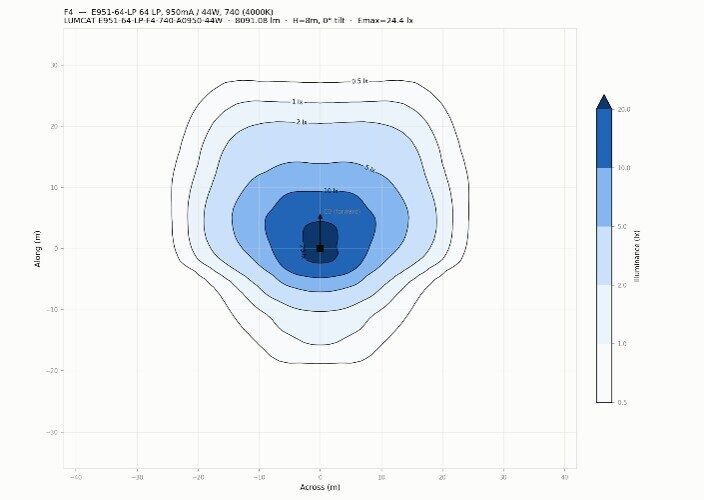
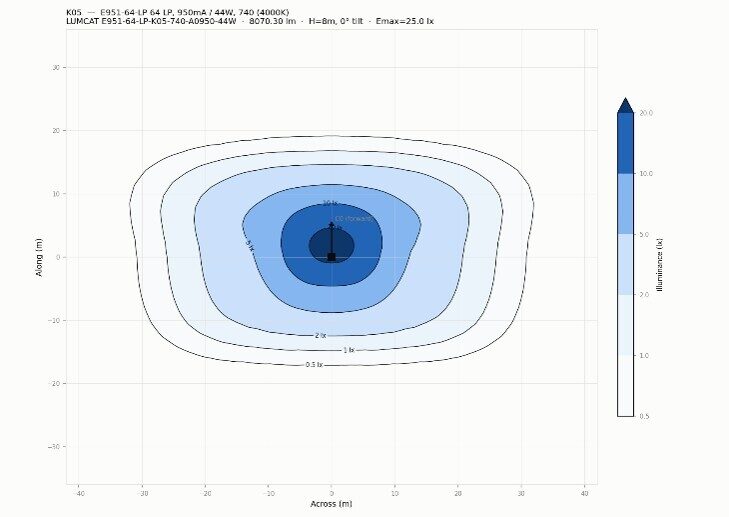
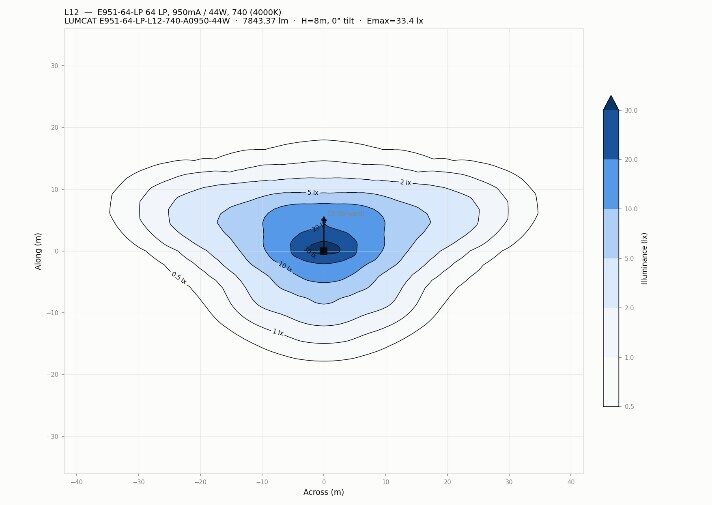
One of the ways lighting designers assess distribution is through an Isolux diagram.
An Isolux diagram uses contour lines to connect points receiving the same level of illuminance, usually expressed in lux. This provides a visual representation of how light is spread across a surface.
Designers can use these diagrams to understand the coverage provided by different optical distributions and identify areas where illumination may be concentrated or reduced.
LIGHTING DESIGNER'S TIP – IRINA PIRTAC
“An Isolux diagram is a useful way to visualise where light is going, but it's important to look beyond the overall coverage. The appropriate mounting arrangement must be carefully evaluated to achieve the required uniformity and to ensure that obtrusive light is effectively contained.”
HOW IS PHOTOMETRIC DATA CREATED?
Accurate lighting design depends on reliable photometric data. At C.U. Phosco, this information is generated through testing at our in-house ISO17025 UKAS-accredited laboratory.
Photometric measurements are carried out in accordance with BS EN 13032-1, BS EN 13032-4 and IES LM-79 standards, using our self-designed and constructed Type C goniophotometer.
Before testing begins, the luminaire is mounted in its intended operating position and allowed to stabilise under controlled environmental conditions.
During measurement, the luminaire rotates through 360 degrees around the C-axis, while a mirror assembly scans gamma angles from 0 to 180 degrees. Luminous intensity measurements are captured at defined intervals, collecting thousands of data points to build a three-dimensional representation of how the luminaire distributes light.
Dedicated software processes this information alongside electrical parameters and ambient temperature measurements to calculate key performance characteristics, including luminous intensity distribution, total luminous flux and overall system efficacy, expressed in lumens per watt (lm/W).
Once the results have been reviewed, the software generates an IES photometric file and an LM-79 test report is issued.
The process is repeated for different LED module and lens combinations, creating a unique photometric file for each optical configuration.
FROM LABORATORY MEASUREMENTS TO LIGHTING DESIGN
The photometric files generated in the laboratory provide the information needed to model how a luminaire will perform within a proposed lighting scheme.
Using the appropriate photometric file, designers can carry out lighting calculations, assess the results against the project requirements and refine the design where necessary.
LIGHTING DESIGNER'S TIP – IRINA PIRTAC
“The first calculation is rarely the end of the process. We review the results, assess how the light is distributed and make adjustments where needed. Achieving the design parameters and meeting the target values set by the standards is only part of the design process. We also assess the lighting impact and visual comfort. Sometimes a change of optic can make all the difference without changing the luminaire itself.”
GETTING THE RIGHT LIGHT IN THE RIGHT PLACE
Effective exterior lighting requires careful consideration of how light is distributed, the needs of the people using the space and the potential impact on the surrounding environment.
By combining accurate photometric measurements with a structured lighting design process, designers can make informed decisions about luminaire and optic selection, helping to deliver lighting that performs as intended.
At C.U. Phosco, the connection between in-house photometric testing and lighting design supports this approach, ensuring that optical selection is based on measured performance and the specific requirements of each project.
NEED HELP WITH YOUR LIGHTING DESIGN?
From selecting the right luminaire and optics to developing a complete lighting scheme, our experienced lighting design team is here to help.
C.U. Phosco offers a complimentary exterior lighting design service, tailored to your project's requirements.
Get in touch to find out more.